Sathwik Reddy Majji

Sathwik Reddy Majji

Vikram Sarabhai Space Centre (VSSC), ISRO
Thiruvananthapuram, Kerala 695022, India

I am a Scientist/Engineer in the Cloud Computing Section at Vikram Sarabhai Space Centre (VSSC), ISRO. I am actively involved in contributing to several flagship research endeavours including quantum computing applications, machine learning for space systems, computer vision for satellite imagery, and cloud computing infrastructure. My work involves tackling diverse challenges in space technology and quantum-assisted data processing.

I am also engaged in notable technology demonstration projects, including Proxmox-based cloud workstation infrastructure using NVIDIA vGPU technology, quantum processing of SAR imagery, and AI-based defect detection systems for space-grade components.

Before joining ISRO, I graduated from Indian Institute of Space Science and Technology (IIST) with a B.Tech in Electronics and Communication Engineering (CGPA: 8.02), having earned the prestigious Department of Space Merit Scholarship from the Government of India. At IIST, I conducted research to develop quantum-assisted image processing methods in the Department of Electronics and Communication under Prof. B.S. Manoj.

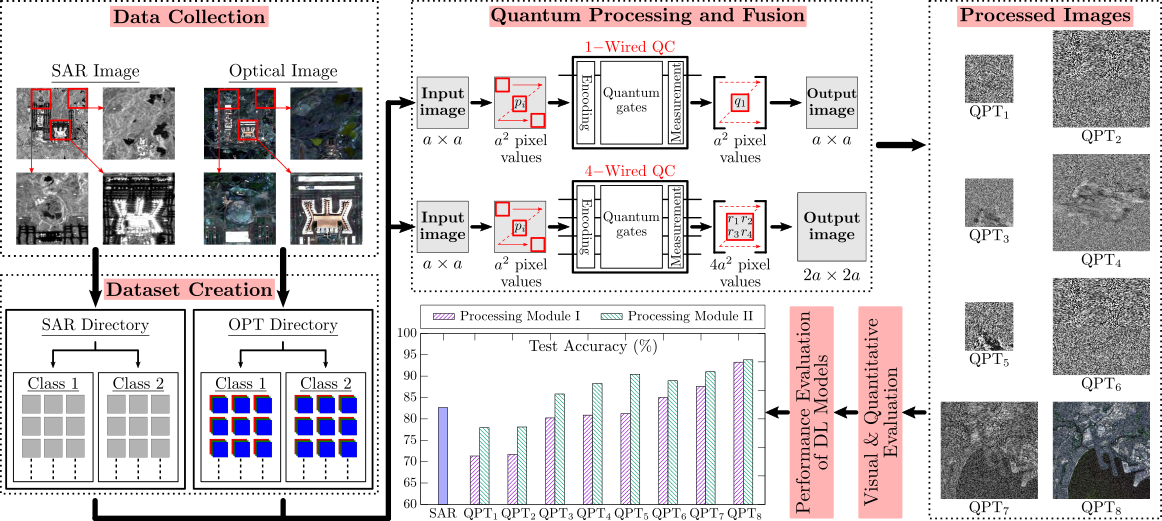
Following my graduation, I had the opportunity to work at Advanced Data Processing Research Institute (ADRIN) as a Graduate Researcher. There, I collaborated with Dr. Raghavendra Kune and developed quantum-based image fusion techniques integrating SAR and optical imagery, improving CNN classification accuracy from 82.64% to 95.36%.

In a more general sense, I am interested in Quantum Computing, Machine Learning, Computer Vision, and Space Technology. I am particularly fascinated by the intersection of these fields and their applications in satellite data processing and space missions. I am always on the lookout for exciting research opportunities and collaborations, so feel free to reach out if you have any ideas or projects in mind.

news

Aug 2025: Delivered an invited talk on 'Quantum Computing: The Future of Technology and Innovation' at GH Raisoni College of Engineering, Nagpur, India.
Jan 2025: Our paper "Enhancing Image Restoration with Quantum-Integrated Contrastive Adversarial Networks" accepted at IEEE INDISCON 2025.
Oct 2024: Presented "Spacecraft Manipulator System Simulator" at IEEE SPACE 2024 conference.
Feb 2025: Promoted to Cloud Computing Section at VSSC, ISRO, working on Proxmox-based cloud workstation infrastructure.
2024: Coordinated Yuvika 2024 – ISRO Student Outreach Program, guiding over 100 high school students.
2023: Published "Quantum Approach to Image Data Encoding and Compression" in IEEE Sensors Letters.

selected publications

Publication 1

Enhancing Image Restoration with Quantum-Integrated Contrastive Adversarial Networks

Satvik Raghav, Sathwik Narkedimilli, Sathwik Reddy Majji, Msvpj Sathvik
IEEE INDISCON 2025

This paper presents a novel approach to image restoration by integrating quantum computing principles with contrastive adversarial networks. Our quantum-enhanced method demonstrates improved performance in noise reduction and feature preservation across various image degradation scenarios...

Publication 2

Spacecraft Manipulator System Simulator

Anumandla Sukrutha, Gopalakrishnan L, Pallabi Sinha, Pranay Pallav Tripathi, Raghav Hariharan, Sathwik Reddy Majji, Shikhar D, Sreelatha A
IEEE SPACE 2024

We present a comprehensive MATLAB-based simulator for free-floating spacecraft manipulators using Lagrangian formulation. The simulator features configurable links, inertias, joints, DH parameters, and end-effectors, validated against MuJoCo for accurate zero-gravity multi-body dynamics...

Publication 3

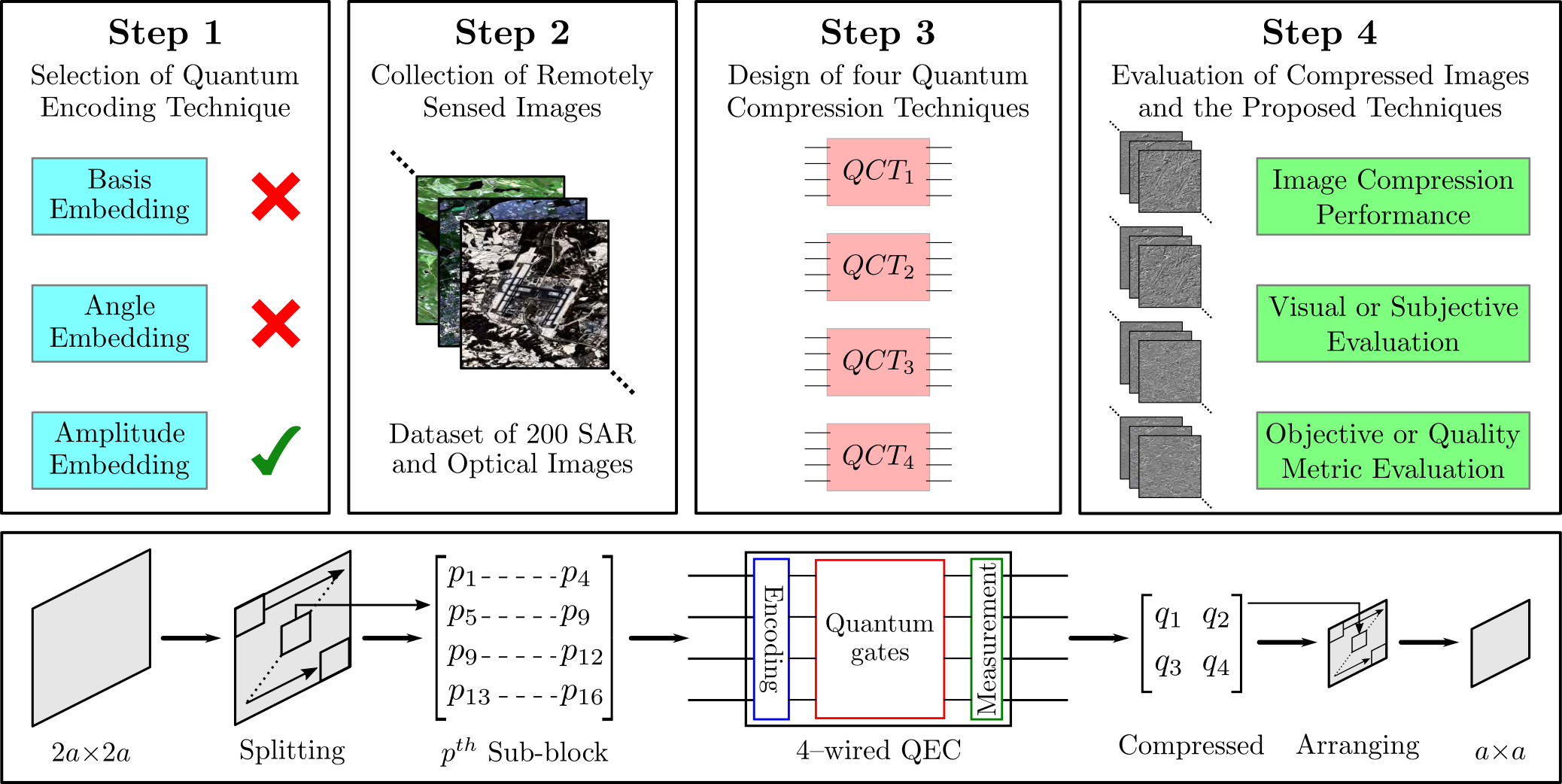
Quantum Approach to Image Data Encoding and Compression

Sathwik Reddy Majji, Avinash Chalumuri, B. S. Manoj
IEEE Sensors Letters, 2023

This work introduces quantum-based methods for image compression using scalable amplitude embedding. We propose four compression strategies and demonstrate that key image patterns are preserved at up to 75% compression rates, enabling effective subsequent processing...